Introduction
Snapshot: The Main Taxes Illinois Residents Pay
– 2.1 Income tax – 2.2 Sales tax – 2.3 Property tax – 2.4 Corporate and business taxes – 2.5 Other taxes and fees
How Illinois’ Tax Structure Compares to Other States
– 3.1 Income tax: flat vs. progressive and no-tax states – 3.2 Sales tax: state rate and local add-ons – 3.3 Property tax: where Illinois stands – 3.4 Business and corporate tax competitiveness – 3.5 Overall state and local tax burden
Who is Most Affected by Illinois’ Mix of Taxes?
– 4.1 Low- and middle-income households – 4.2 Homeowners and high-property-value areas – 4.3 Businesses and investors – 4.4 Retirees
Trade-offs — What Illinois Gets for Its Taxes
– 5.1 Education and local services – 5.2 Infrastructure and capital projects – 5.3 Pension liabilities and debt service
Practical Tips for Residents and Businesses to Manage Tax Exposure
– 6.1 Personal strategies – 6.2 Business and planning strategies – 6.3 Local choices: where you live matters
Policy Directions and Likely Future Trends
– 7.1 Potential shifts to progressive rates or new revenue sources – 7.2 Property tax relief and local funding debates – 7.3 Business tax competitiveness actions
Conclusion
Frequently Asked Questions (FAQ)
How Taxes in Illinois Compare to Other’s States. If you live in or are considering a move to the Midwest, understanding Illinois taxes is essential. Illinois’ combination of a flat personal income tax, relatively high property levies, and substantial sales taxes shapes the cost of living and the business climate. This article compares Illinois’ tax system with other states across major categories—income, sales, property, and corporate taxes—explaining who is most affected, what residents receive in return, and practical steps to manage tax exposure.

How Taxes in Illinois Compare to Other’s States And How Out Of Hand Things really Are In Illinois.
Early in the discussion we’ll address core topics such as Illinois’ flat income tax rate, the state sales tax plus local add-ons, and why property taxes are frequently cited as among the nation’s highest. These comparisons will help you place Illinois in the national tax landscape and weigh the trade-offs behind those numbers.
- Snapshot: The Main Taxes Illinois Residents Pay
Before comparing across states, it helps to summarize the main revenue streams Illinois relies on and how they are applied.
2.1 Income tax
Illinois relies on a flat individual income tax. Unlike progressive systems that tax higher incomes at higher marginal rates, Illinois applies the same rate across taxable income levels. That simplicity is often promoted as fair and predictable, though it has distributional consequences compared with progressive regimes.
2.2 Sales tax
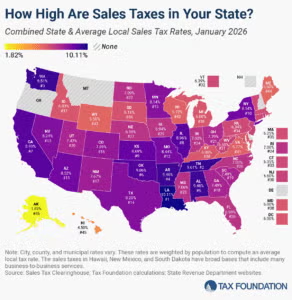
The state levies a statewide sales tax that is then supplemented by county, city, and special district taxes. Because many municipalities add their own sales taxes, the combined rate that consumers pay at the register can be significantly higher than the state base rate, especially in major metropolitan areas.
2.3 Property tax
Local property taxes in Illinois fund schools, parks, police and fire protection, and other municipal services. Illinois consistently reports among the highest effective property tax rates in the country, creating a substantial ongoing cost for homeowners and real estate investors.
2.4 Corporate and business taxes
Corporations in Illinois face a state corporate income tax as well as additional business-related levies. When state corporate taxes are combined with replacement or franchise taxes that apply to businesses, Illinois’ effective business tax rates land toward the higher end among states, which matters for business location and expansion decisions.
2.5 Other taxes and fees
Additional state revenues come from motor fuel taxes, excise taxes (alcohol, tobacco), license and registration fees, and taxes on estate or inheritance in certain situations. Local governments also rely on fees and special assessments.
- How Illinois’ tax structure compares to other states
3.1 Income tax: flat vs. progressive and no-tax states
Illinois’ flat personal income tax rate is one distinguishing feature. Nationally, states follow three broad approaches:
- No broad-based individual income tax (e.g., Florida, Texas, Washington, Wyoming). These states shift more of their revenue needs onto sales, property, and business taxes.
- Flat-rate personal income tax states (e.g., Illinois, Colorado, Indiana). A single tax rate applies to most taxable income.
- Progressive-rate states (e.g., California, New York) with multiple tax brackets and higher top marginal rates for high earners.
Compared with states that levy no income tax, Illinois collects revenue directly from wage and investment income, which can make its tax burden feel higher for salaried workers. Compared with progressive-tax states, the flat rate is simpler but lacks the automatic progressivity that raises more revenue from high-income households.
3.2 Sales tax: state rate and local add-ons
Illinois has a moderate-to-high state sales tax base, but the practical impact is amplified by ubiquitous local sales taxes. Some states have no state sales tax (e.g., Oregon, New Hampshire); others have low base rates and limited local add-ons. Illinois’ combined state-plus-local rates in many areas put it above the national median for what consumers ultimately pay on purchases.
Because sales taxes tend to be regressive (they take a larger share of income from lower earners), a reliance on sales tax revenue can raise equity concerns compared with states that emphasize income taxes.
3.3 Property tax: where Illinois stands
On an effective rate basis (taxes paid as a share of home value or household income) Illinois frequently ranks among the highest in the nation. New Jersey and New Hampshire are other examples of states with very high property tax burdens, but Illinois stands out for both the level of local levies and the fragmentation of taxing bodies—many separate districts and boards levy taxes, particularly for schools.
High property taxes have direct implications for homeowners’ monthly budgets, long-term affordability, and the attractiveness of Illinois housing markets.
3.4 Business and corporate tax competitiveness
Illinois applies a corporate income tax plus business replacement taxes and often has a higher combined effective rate than many neighboring states. This can make Illinois less competitive for certain sectors or encourage strategies such as locating headquarters or certain operations in lower-tax states. However, businesses also weigh access to markets, labor pools, infrastructure, and supply chains—factors that can offset tax differences.
3.5 Overall state and local tax burden
When accounting for all taxes—income, sales, property, and business—Illinois typically places in the top third of states for state-and-local tax burden per capita or as a share of personal income. Rankings fluctuate year by year with policy changes, but Illinois’ mix often produces a higher-than-average tax bite compared with the U.S. median.
- Who is most affected by Illinois’ mix of taxes?
4.1 Low- and middle-income households
Because Illinois depends significantly on sales and property taxes, lower-income households can face proportionally higher tax burdens. Sales taxes on essentials and services hit day-to-day spending, and property taxes can raise rent or increase costs for homeowners.
4.2 Homeowners and high-property-value areas
For homeowners, particularly in suburban and high-value neighborhoods, property taxes are a persistent and significant annual cost. School district levies and local referenda can further increase bills in certain communities, affecting affordability and mobility decisions.
4.3 Businesses and investors
Businesses that are capital-intensive or own significant property pay higher local property taxes. Corporations evaluate the combined corporate tax and replacement tax rates when making investment decisions; evidence suggests some firms weigh state tax differences as part of their location strategies.
4.4 Retirees
Retirees’ exposure depends on retirement income composition. Illinois generally exempts some retirement income (for example, Social Security benefits are not subject to state income tax), and pension and retirement-income tax treatment is often favorable relative to some other states. Still, property taxes and sales taxes can significantly affect fixed-income households.
- Trade-offs — What Illinois gets for its taxes
Taxes are not ends in themselves; they fund services and obligations. Assessing Illinois’ tax picture means evaluating what the revenue supports.
5.1 Education and local services
A large share of property tax revenue funds public education. Local control means districts can raise revenue for schools through property levies, but it also creates wide disparities and pressure to maintain high tax rates to support teacher pay and facilities.
5.2 Infrastructure and capital projects
State and local taxes fund transportation networks, municipal services, and capital projects. Periodic state capital bills and federal matching funds support road and transit projects that benefit commerce and daily life.
5.3 Pension liabilities and debt service
A notable factor shaping Illinois finances is long-standing underfunded pension liabilities and associated debt-service costs. Much of recent revenue growth has gone to pension payments and debt obligations, which constrains available funds for other priorities and influences calls for reform or revenue increases.
- Practical tips for residents and businesses to manage tax exposure
6.1 Personal strategies
- Maximize credits and exemptions: Low-income families and seniors may qualify for property tax relief programs, circuit breaker credits, or state tax credits—check eligibility.
- Retirement and filing choices: Understand how Illinois treats retirement income. Where possible, plan withdrawals and account types to take advantage of state exemptions.
- Timing and itemization: Illinois tax rules often begin with federal AGI; tax planning that reduces federal taxable income can reduce state liability. Consult a tax professional before making big moves.
6.2 Business and planning strategies
- Evaluate total tax burden: When choosing locations, consider property taxes, state corporate tax and replacement taxes, and sales- or excise-tax exposure alongside labor costs.
- Take advantage of credits: Illinois offers various business incentives, tax credits, and economic development programs—R&D credits, enterprise zone incentives, and others—that can offset some tax costs.
- Structure operations strategically: Multistate companies can legally structure activities to minimize nonessential tax exposure, e.g., by placing certain functions in lower-tax jurisdictions, but always consult tax counsel.
6.3 Local choices: where you live matters
Within Illinois, tax burdens vary widely by county and municipality. A community with a lower property tax levy may have fewer local services or a different school funding model. Picking the right neighborhood can materially affect annual taxes, school quality, and property appreciation.
- Policy directions and likely future trends
7.1 Potential shifts to progressive rates or new revenue sources
Policymakers sometimes debate moving from a flat to a progressive income tax, broadening the base, or introducing new revenue streams. These discussions surface periodically, driven by budget pressures and equity concerns.
7.2 Property tax relief and local funding debates
Because property taxes are politically sensitive, reforms often focus on relief programs, consolidation of taxing districts, or changing the balance between state aid and local levies—each with trade-offs for services and equity.
7.3 Business tax competitiveness actions
To retain and attract businesses, states sometimes lower corporate rates, expand credits, or streamline regulations. Illinois policymakers continually weigh competitiveness against the need to fund core services and address pension obligations.
- Conclusion
Illinois’ tax landscape reflects a set of policy choices: a flat individual income tax that ensures a steady revenue source; a sales tax system with state and local layers that shifts costs to consumption; and property taxes that fund local services but create a heavy burden for homeowners. Compared with other states, Illinois sits above the national median in total tax burden, particularly because of property levies and combined sales taxes, while its flat income tax rate places it between no-income-tax states and high-progressive-rate states.
For residents and businesses, the implications are concrete: living costs, housing affordability, and business operating expenses can be higher than in many states. But taxes pay for schools, public safety, and infrastructure—and Illinois’ fiscal choices have also been shaped by long-term pension and debt obligations.
If you’re deciding whether to move, invest, or expand in Illinois, weigh tax differences alongside non-tax factors such as labor availability, market size, quality of life, and public services. And when possible, consult tax and financial advisors to optimize decisions within Illinois’ tax framework.
- Frequently Asked Questions (FAQ)
Q: Is Illinois considered a high-tax state?
A: Overall, Illinois often ranks above the national median for state-and-local tax burden, especially due to high property taxes and combined sales taxes. Whether it feels “high” depends on personal income, homeownership, and spending patterns.
Q: How does Illinois’ income tax compare to other states?
A: Illinois has a flat individual income tax rate, which is simpler than progressive systems. Several states have no income tax at all, while others have progressive rates with higher top brackets. Illinois is somewhere in the middle in terms of personal income tax impact.
Q: Are property taxes higher in Illinois than in most states?
A: Yes—Illinois is frequently cited among the states with the highest effective property tax rates. Local levies for schools and municipal services drive much of this burden.
Q: Do retirees pay state income tax on pensions in Illinois?
A: Illinois generally provides favorable treatment for many forms of retirement income—Social Security benefits, for example, are exempt from state income tax. Specific treatment can vary by the type of retirement income, so check current rules or consult a tax advisor.
Q: How do Illinois business taxes affect company decisions?
A: Illinois’ combined corporate and business-related taxes are relatively high compared with many states, which can influence decisions about headquarters, plant locations, and expansions. However, businesses also consider labor markets, infrastructure, and customer access when choosing locations.
Q: Can Illinois tax bills be reduced?
A: Residents can pursue tax credits, exemptions, and relief programs (such as property tax relief for seniors or low-income households) if eligible. Businesses can use credits and incentive programs. Consulting a tax professional can reveal the most effective strategies.
If you’d like, I can provide a state-by-state table comparing Illinois to specific states on income, sales, and property tax metrics, or help analyze how moving to or from Illinois might affect your household or business taxhttps://www.irs.gov/businesses/business-taxes bill.